About the 2015 Discovery — How Doc Adams Was Identified as the Author of the Laws of Baseball
The 2015 Research · 158 Years Later
How the Record Was Finally Corrected
For 158 years, the name of the man who wrote the rules of baseball was missing from the historical record. In 2015, a systematic examination of three independent sources finally closed the gap.
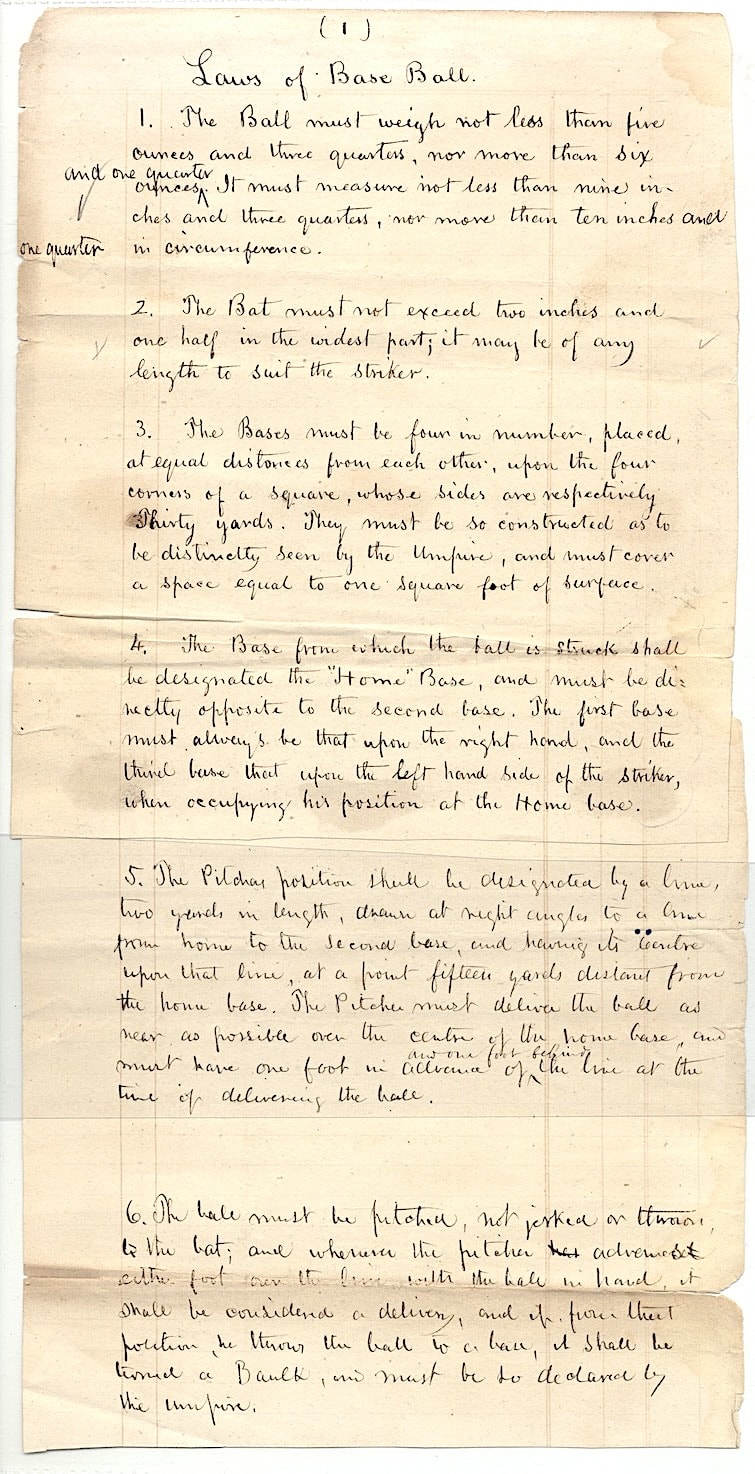
1857 Convention document — the primary evidence
The 158-Year Gap
The Document Existed. The Name Did Not.
The minutes of the 1857 Baseball Convention were not lost. They existed in archives, accessible to researchers. They recorded that the Laws of Baseball were presented by a representative of the Knickerbocker Base Ball Club. What they did not do — at least not in a way that anyone had connected — was name the author.
For 158 years, that gap persisted. Baseball historians wrote about the 1857 Convention. They cited the Laws. They noted the Knickerbocker Club's role. But the specific question — who, within the club, wrote and presented the Laws? — was never systematically pursued.
The answer was in the archives all along. It took a deliberate, cross-source investigation in 2015 to find it.
The Research Process
How the Authorship Was Proven
The Convention Minutes Surface
The minutes of the 1857 Baseball Convention had been held in a private collection for decades. When they became accessible to researchers, they recorded — in plain language — that the Laws of Baseball were presented by a representative of the Knickerbocker Base Ball Club. The author's name was not explicitly stated in the minutes themselves. That was the gap that had persisted for 150 years.
Cross-Referencing Club Records
Knickerbocker Base Ball Club membership records, preserved in fragmented form across several archives, were systematically cross-referenced with the convention minutes. The records identified Adams as the club's president and primary rulemaker during the period leading up to the 1857 Convention — the person who would have been responsible for drafting and presenting the Laws.
Contemporary Newspaper Accounts
Newspaper accounts from 1857 — the New York press covered the Convention — were located and analyzed. Several accounts referenced the presentation of the Laws and the role of the Knickerbocker Club's leadership. When read alongside the club records, they provided corroborating evidence that Adams was the author and presenter.
The Authorship Is Established
The convergence of three independent sources — the convention minutes, the club records, and the contemporary press accounts — established Adams' authorship beyond reasonable historical doubt. No single document contained a smoking-gun attribution. The proof was in the totality of the evidence, carefully assembled for the first time in 2015.
The Evidence
Three Independent Sources
No single document contained an explicit attribution. The proof came from the convergence of three independent sources — each corroborating the others.
Convention Minutes
The official minutes of the 1857 Baseball Convention, recording that the Laws were presented by a Knickerbocker Club representative. The document that started the investigation.
Held in private collection; became accessible to researchers in the years preceding the 2015 analysis.
Club Records
Knickerbocker Base Ball Club membership and officer records, identifying Adams as club president and primary rulemaker during the period 1847–1862.
Preserved in fragmented form across multiple archives; systematically cross-referenced for the first time in 2015.
Contemporary Press
New York newspaper accounts from 1857 covering the Convention, referencing the Knickerbocker Club's leadership role in presenting the Laws.
Located in newspaper archives; provided independent corroboration of the club records and convention minutes.
Setting the Record Straight
What the Discovery Corrects
The Myth
"Alexander Cartwright invented baseball and wrote its rules."
The Record
Cartwright was a founding Knickerbocker and contributed to the club's early organization, but he left New York for California in 1849 — eight years before the 1857 Convention. The Laws Adams presented were developed after Cartwright's departure. The 1953 Congressional resolution crediting Cartwright was based on incomplete research.
The Myth
"The rules of baseball were always well-documented and attributed."
The Record
For most of baseball's history, the authorship of its foundational rules was either unattributed or incorrectly attributed. The 1857 Convention minutes existed in archives but were not systematically analyzed in the context of authorship until 2015. The gap was not a secret — it was simply an unasked question.
The Myth
"Adams' contribution was minor or shared equally among many people."
The Record
Adams served as the Knickerbocker Club's president and sole rulemaker for nearly a decade before the 1857 Convention. The three core structural rules he presented — nine players, ninety-foot bases, nine innings — were his specific innovations, developed through years of practical experimentation. They have not been changed in 169 years.
Why This Matters
The Discovery Is Not Just Historical
"Every game of baseball ever played was played under rules that Doc Adams wrote. That is not a footnote. That is the story."
The 2015 discovery matters because it is not yet complete. Adams' authorship has been established by researchers, but it has not been formally recognized by the institutions that govern baseball's historical record. He is not in the Baseball Hall of Fame. His name does not appear on the plaques that credit the game's founders.
The discovery created an obligation: now that we know, we have to act on what we know. The evidence is in the documents. The case is made. What remains is the advocacy — making sure the people with the authority to correct the record actually do so.
That is what this site is for. Not just to tell the story, but to make the story impossible to ignore.
Now That You Know, Share It.
The more people who know Doc Adams' name, the harder it becomes for the historical record to stay wrong.